
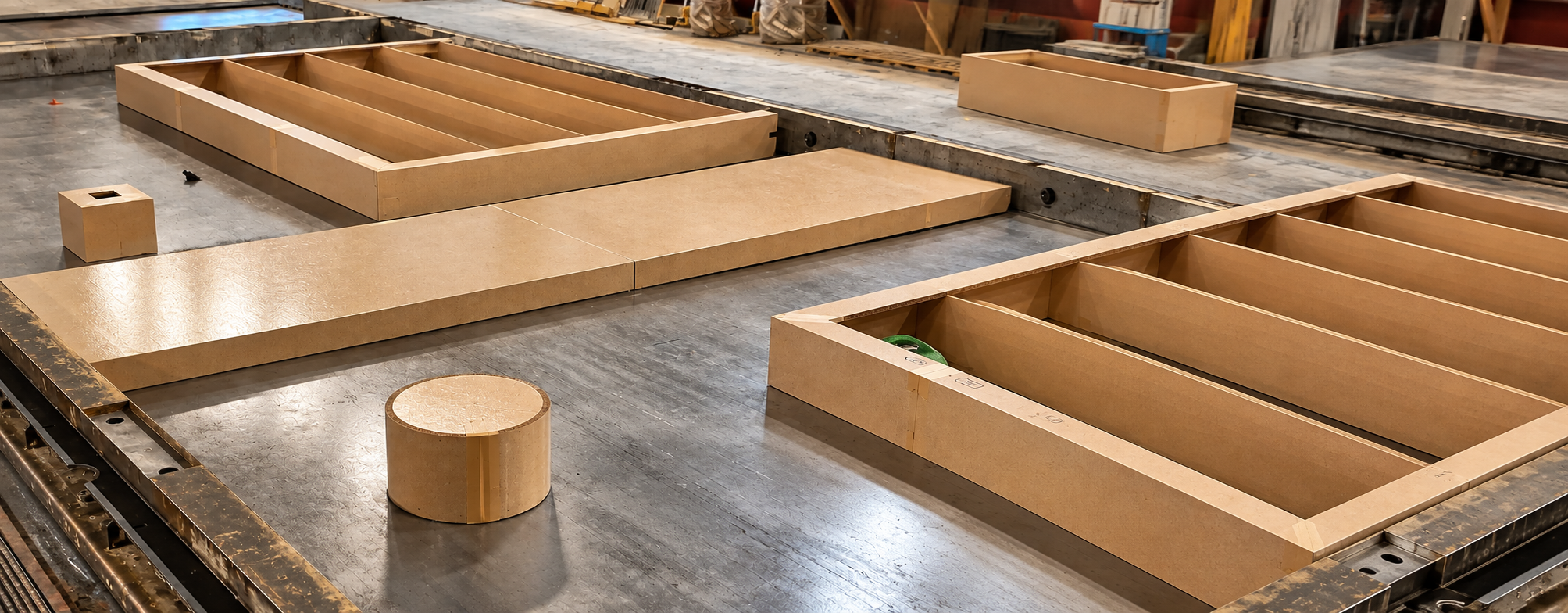
Precast concrete formwork plays a critical role in manufacturing efficiency, influencing everything from mould preparation and labour requirements to surface quality and production flexibility.
For precast manufacturers looking to improve productivity, reviewing the materials used in their moulding systems can be an effective starting point.
While traditional timber, plywood and steel moulds remain essential in many applications, innovative formwork materials are introducing new ways to simplify production without necessarily replacing existing equipment.
Why Precast Concrete Formwork Matters
Formwork determines the shape, dimensions and surface characteristics of precast concrete elements.
It also influences how easily moulds can be prepared, adjusted, cleaned and dismantled after casting.
An efficient formwork system should support three important objectives:
- Consistent concrete quality.
- Practical and efficient manufacturing processes.
- Flexibility to accommodate different project requirements.
When formwork materials are difficult to process or require extensive preparation, they can create unnecessary work throughout the production cycle.
5 Ways Precast Concrete Formwork Can Improve Efficiency
1. Reduce Precast Formwork Preparation Time
Some traditional moulding surfaces require release agents, such as oils or waxes, to facilitate demoulding.
Specialist non-stick mould liners can eliminate this requirement in suitable applications.
Reducing preparation stages can simplify workflows and help production teams spend less time preparing moulds between pours.
2. Simplify Cutting and Adjustments
Precast manufacturers frequently need to create openings, dividers, recesses and other customised features.
Materials that can be cut and adjusted using standard workshop tools make it easier to accommodate changing project requirements.
This flexibility can be particularly useful for short production runs or customised precast elements.
3. Improve Surface Consistency
The quality of a concrete finish depends on several factors, including the condition and characteristics of the mould surface.
Using appropriate mould liners can help achieve smooth, consistent results and reduce the need for certain finishing operations.
The correct material selection should always consider the required finish, concrete mix and production conditions.
4. Reduce Handling Requirements
Heavy or difficult-to-handle mould components can increase preparation effort.
Lightweight liner materials may be easier to position, cut and install, particularly when creating complex shapes or modifying existing moulds.
This can make routine production tasks more manageable for manufacturing teams.
5. Support More Efficient Material Use
Material selection can also influence waste generation.
Large-format sheets, optimised cutting layouts and recyclable materials can create opportunities to reduce offcuts and improve material utilisation.
For manufacturers working towards sustainability objectives, these considerations are becoming increasingly relevant.
Introducing Paper-Based Mould Liners for Precast Concrete
One development in precast manufacturing is the use of specialist paper-based fibreboard as an alternative moulding surface.
Unlike conventional plywood or timber liners, engineered fibreboard solutions can offer a combination of lightweight handling, easy processing and smooth concrete contact surfaces.
Swedboard EMS is one example of this approach.
Made from responsibly sourced wood fibres, it is designed for precast moulding applications and can be integrated with existing mould systems.
Its non-stick surface is designed to facilitate demoulding without release agents in suitable applications.
Where Can Precast Concrete Mould Liners Be Used?
Depending on the production requirements, specialist mould liners can support applications such as:
- Wall panels and slabs: flat casting surfaces and mould liners.
- Windows and door openings: internal shuttering and detailed openings.
- Beams and columns: dividers and adjustable pour stops.
- Architectural elements: grooves, ribs, recesses and decorative features.
- Service penetrations: void formers and block-outs.
These applications demonstrate how alternative materials can support both everyday manufacturing and more specialised precast projects.
Improve Precast Production Without Replacing Equipment
One of the advantages of certain modern mould liner systems is their compatibility with established manufacturing processes.
Rather than investing in entirely new moulding equipment, manufacturers can explore replacing or supplementing individual mould components.
This creates an opportunity to test alternative materials on selected applications before considering wider adoption.
Explore a More Efficient Approach to Precast Formwork
At The Material Solutions Group (tMSG), we help manufacturers explore practical solutions for improving precast production.
Through Swedboard EMS, we offer an alternative approach to mould liners that combines manufacturing flexibility with straightforward integration into existing processes.
Interested in seeing how this technology works?
Download our free brochure to explore the material, its benefits and potential applications.